How to Align Business Strategy with Technology Decisions
11 February 2026 | Digital Transformation
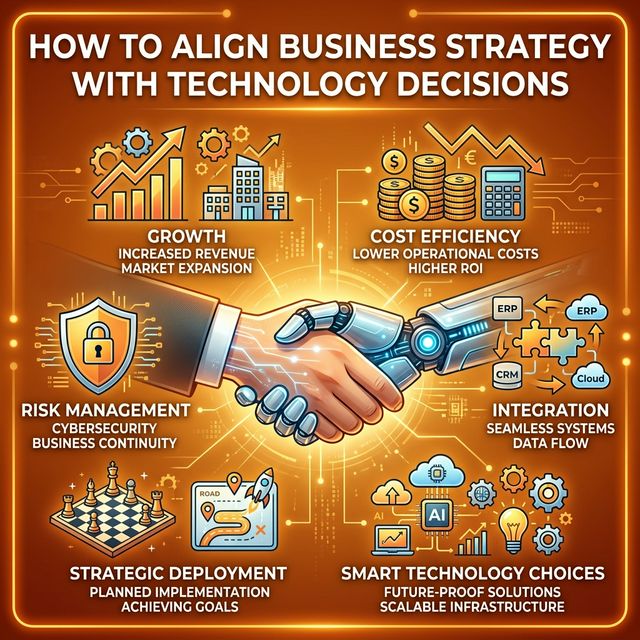 Aligning business strategy with technology decisions helps organizations drive growth, improve cost
efficiency, and manage risk effectively in 2026.
Aligning business strategy with technology decisions helps organizations drive growth, improve cost
efficiency, and manage risk effectively in 2026.
The Strategy–Technology Gap (And Why It Exists)
Many businesses say they have a strategy.
Many businesses also invest heavily in technology.
Yet surprisingly often, the two are not connected.
This disconnect—known as the strategy–technology gap—happens when technology decisions are made in isolation from business goals. Leaders may aim for growth, efficiency, or risk reduction, while technology teams focus on implementing tools without a clear link to outcomes.
In 2026, as global markets become more competitive and digital-first, this gap is one of the biggest reasons SMBs struggle to see value from their technology investments.
Why “Tool-First” Thinking Fails
A common mistake businesses make is starting with the question:
“Which tool should we buy?”
Instead, the better question is:
“What problem are we trying to solve?”
Tool-first thinking often leads to:
- ✔ Multiple platforms that don’t integrate
- ✔ High subscription costs with low usage
- ✔ Frustrated teams and poor adoption
- ✔ Technology that looks modern but delivers little value
Technology should never lead strategy. It should enable it. Leading consulting firms consistently emphasize that successful digital initiatives begin with business intent—not software selection.
Aligning Technology with Business Goals
To create alignment, technology decisions should clearly support one or more of the following core business objectives:
1. Growth
If growth is the goal, technology should help you:
- ✔ Reach new markets
- ✔ Improve customer experience
- ✔ Scale operations without adding complexity
Examples include CRM systems, eCommerce platforms, and data-driven marketing tools—but only when chosen with a clear growth plan.
2. Cost Efficiency
If cost control is a priority, technology should:
- ✔ Automate repetitive tasks
- ✔ Reduce manual errors
- ✔ Improve operational visibility
Automation, cloud optimization, and integrated financial systems are common enablers—but only when aligned to process improvement.
3. Risk Management
If managing risk is critical, technology should:
- ✔ Strengthen cybersecurity
- ✔ Improve data privacy and compliance
- ✔ Reduce operational dependency on individuals
Security tools, governance frameworks, and access controls become strategic—not just technical—investments.
A Simple Decision Framework Used by Consultants
Global consulting firms use structured decision frameworks to guide technology investments. A simplified version looks like this:
- ✔ Define the business objective (What are we trying to achieve?)
- ✔ Identify impacted processes (Which parts of the business will change?)
- ✔ Assess current capabilities (What do we already have?)
- ✔ Evaluate technology options (Which solutions best support the goal?)
- ✔ Measure expected value and risk (What is the ROI and downside?)
This approach ensures that every technology decision can be traced back to a clear business outcome.
Real-World Alignment Examples
Example 1: Scaling Without Chaos
A growing services company wanted to expand internationally. Instead of buying multiple regional tools, they aligned their technology strategy around a single, cloud-based platform that supported global operations and compliance. The result: faster expansion and lower operational complexity.
Example 2: Improving Efficiency
A retail SMB struggling with manual reporting aligned its technology investments to one goal—operational efficiency. By integrating data across systems and automating reports, leadership gained real-time insights and reduced decision delays.
In both cases, success came not from more technology—but from better alignment.
Why Alignment Matters More in 2026
In today’s global environment:
- ✔ Customers expect seamless digital experiences
- ✔ Regulations are more complex across regions
- ✔ AI and data tools are widely accessible
- ✔ Budgets are under pressure
This makes strategic alignment between business goals and technology decisions a competitive advantage—not a luxury.
Final Thoughts
Technology is a powerful enabler—but only when guided by clear business strategy. SMBs that succeed in 2026 will be those that stop chasing tools and start building purpose-driven digital ecosystems.
Alignment doesn’t require massive budgets or complex systems. It requires clarity, structure, and the discipline to connect every technology decision to business value.
Ready for Strategic Alignment?
At Recoupl, we help businesses align strategy, technology, and execution—so every digital investment delivers measurable impact.
Get strategic tech guidance and start making technology work for your business, not against it.